

Sourcing and Recruiting in the Age of AI: What Is Still Truly Human?
Introduction
I’m just back from Sourcing Summit in Amsterdam. Two days of talks, and one thing stood out clearly: almost every solution on show had the same goal. Automate what humans do in recruiting. Sourcing, qualification, outreach, nurturing. Language models analyze career paths in depth and personalize outreach at scale, with no particular effort.
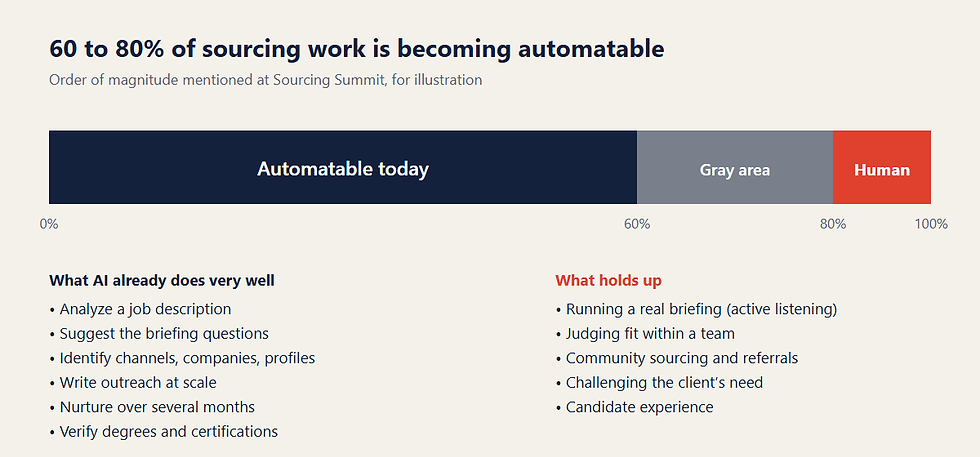
That raises a simple but uncomfortable question. When 60 to 80% of sourcing work becomes automatable, what is left for someone who has spent 10, 15, even 20 years practicing it?
I don’t want to write an alarmist article, or sell an illusory resistance to AI. The idea is to map precisely what is shifting, what is disappearing, and what holds up, for now.
What AI Already Does Very Well
Let’s be honest about what is changing. AI understands a job description and extracts the essential criteria. It also helps build the list of questions to ask the client to get a fairly detailed briefing and know where to search. And nothing stops you from going further: with a base of 30, 50 or 100 standard questions, it can automatically propose the briefing questions as soon as the job description arrives.
It identifies relevant channels, companies and profiles at a scale no human can match alone. It writes personalized outreach messages in seconds, for hundreds of profiles at once.
It goes even further. It cross-references sources to rebuild a full career path, spots weak signals in a candidate’s professional history, and runs nurturing sequences over several months without ever getting tired or forgetting to follow up.
And on one specific point, it is even more reliable than we are. Validating a degree, a certification, a methodology mastered on paper is factual and verifiable, and a machine doesn’t make careless mistakes where a human might.
This part of the job, the part we used to call sourcing, is becoming a commodity.
What Remains Hard to Automate
There is one place where AI still stumbles, and I don’t think it’s just a matter of time. It is running the briefing itself.
Generating a list of relevant questions from a job description is something an AI can do, and already does. But a briefing is not a list of questions asked in order. It is a conversation. The client says one thing, then contradicts themselves three minutes later without noticing. They insist on a criterion that isn’t really theirs but their own manager’s. They look for a profile that resembles someone they loved hiring, without ever putting it that way. Sensing that, digging where the answer sounds off, going back to a point misunderstood ten minutes earlier, is active listening work that no one has managed to automate seriously.
The same goes on the candidate side. Validating a degree or a certification is factual. Validating that someone will fit into a team, handle the pressure of a particular manager, and thrive in a specific company culture takes a fine reading that only a human who has lived through dozens of successful and failed integrations can truly bring.
Then there is community sourcing. In niche markets, the best profiles don’t respond to a message, however well written. They respond to a recommendation. From someone they know and respect in their community. This social proof can’t be automated, because it rests on a relationship built over time, not on a volume of messages sent.
Value That Shifts but Doesn’t Disappear
What is happening is not the disappearance of the profession. It is its displacement.
Sourcing as execution, going out to find profiles one by one on LinkedIn or elsewhere, loses value with every passing month. But alongside it, one role is gaining importance: strategic advice upfront. Helping a client rethink their need before even looking for a candidate. Telling them that the role as written will find nobody, or that the market they are targeting doesn’t exist in those terms. No AI solution really does that today, because it means challenging the client, not answering their request as is.
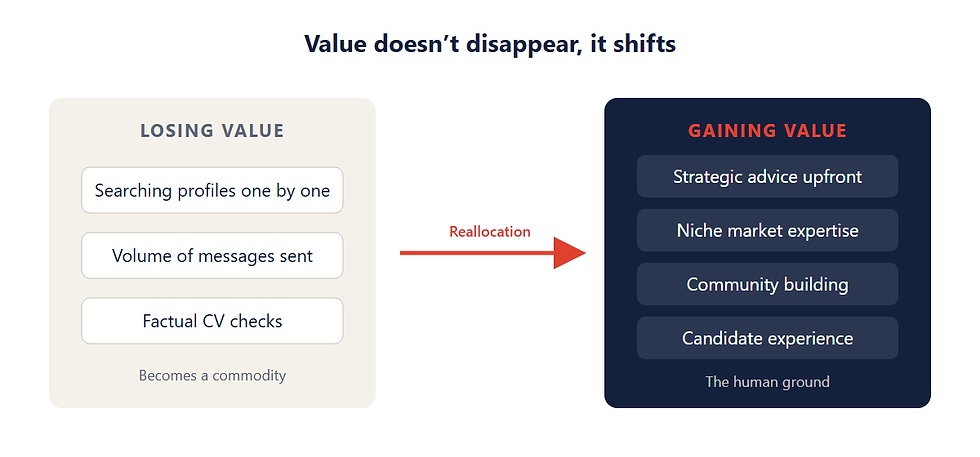
Fine knowledge of a niche market also becomes an asset in its own right. Not the general knowledge an AI can rebuild by cross-referencing databases, but the kind that comes from years spent following the same companies, the same profiles, the same career moves in a specific sector. It is what lets you tell a client, before even launching a search, that a given company has just lost three key engineers, or that a certain profile simply doesn’t exist in the targeted market.
Finally, employer branding and candidate experience remain a human territory. You can automate sending a message. You can’t automate how a candidate feels considered, listened to and respected throughout a process. And in a market where the best profiles receive dozens of automated approaches every week, that difference becomes more and more visible.
What This Means in Practice for Experienced Recruiters
For someone with 10, 15 or 20 years in the profession, this shift is not bad news. It is a reallocation of time.
Less time spent searching for profiles one by one, more time spent challenging clients’ needs, building real relationships with candidates, and nurturing a community in your niche market.
Repetitive manual sourcing, which filled most of our days only a few years ago, becomes a safety net rather than a core activity.
The skills to strengthen are not new, they were simply less visible until now. Active listening to run a briefing that goes beyond the job description. The sometimes uncomfortable questioning of the need the client expresses. The ability to build and maintain a community, not just a contact database.
At its core, the profession is narrowing around what AI cannot, or not yet, replicate. And for those who have spent years developing this relational know-how, often without naming it precisely, this narrowing is more an opportunity than a threat.
The Risk of the “Skills Wall”
There is an angle we can’t ignore, and it doesn’t only concern experienced recruiters. It is a risk for the entire industry.
Today, anyone can buy or build an AI sourcing solution without ever having recruited anyone. The problem is not access to the tool. It is that these people will use it without understanding what it actually does, why it suggests one profile rather than another, or in which cases it gets things wrong.
And that is where it becomes worrying. If an entire generation of recruiting professionals learns the craft through tools rather than through field practice, they will never have developed the instincts to detect an error, a bias, an answer that sounds right but isn’t. We then hit a skills wall. Almost no one left to challenge what the machine says, because no one has learned how.

This is not just an individual problem. It is a collective problem for the whole industry. Passing on the expertise of the craft, training new recruiters to understand the substance rather than follow the tool, becomes almost an act of preservation, not just a competitive advantage for a firm.
Conclusion
Sourcing doesn’t disappear. It refocuses.
What used to be the heart of the job, execution, searching for profiles, the volume of messages sent, becomes a commodity that AI handles very well, and better and better. What remains is what has always been the hardest to teach and the longest to build. The ability to truly listen to a client, to sense what they leave unsaid. The trust a candidate places in a human recommendation rather than an automated message. The judgment to challenge what a machine proposes, rather than trusting it blindly.
AI automates execution. Humans remain the guarantors of judgment and trust. For those who have spent years building this expertise, it may be the best news yet: they can finally put it to full use.


Comments